The physiological constraint.
Human spaceflight to date has been conducted under a physiological compromise. Astronauts accept muscle atrophy, bone demineralisation, fluid redistribution, and cardiovascular deconditioning as occupational costs. Countermeasures—resistance exercise, pharmacological interventions, compression garments—mitigate but do not eliminate these effects. The current model works because missions are short, crew sizes are small, and selection criteria are narrow. The International Space Station operates with 3-7 personnel at a time, rigorously screened, continuously monitored, and rotated back to Earth before degradation becomes unmanageable.
This approach does not scale to industrial operations. A cislunar economy requires workforces in the dozens, then hundreds. It requires tenures measured in years, not months. It requires personnel who are not test pilots or research scientists but engineers, fabricators, quality inspectors, logistics coordinators—roles that demand spatial reasoning, fine motor control, and sustained physical endurance. Microgravity is not a neutral environment for these tasks. It is a persistent drag on productivity, safety, and retention.
The threshold question for any orbital infrastructure programme is not whether artificial gravity is desirable. It is whether the programme can function at industrial scale without it. West Galactic's conclusion: it cannot.
Rotation as the solution.
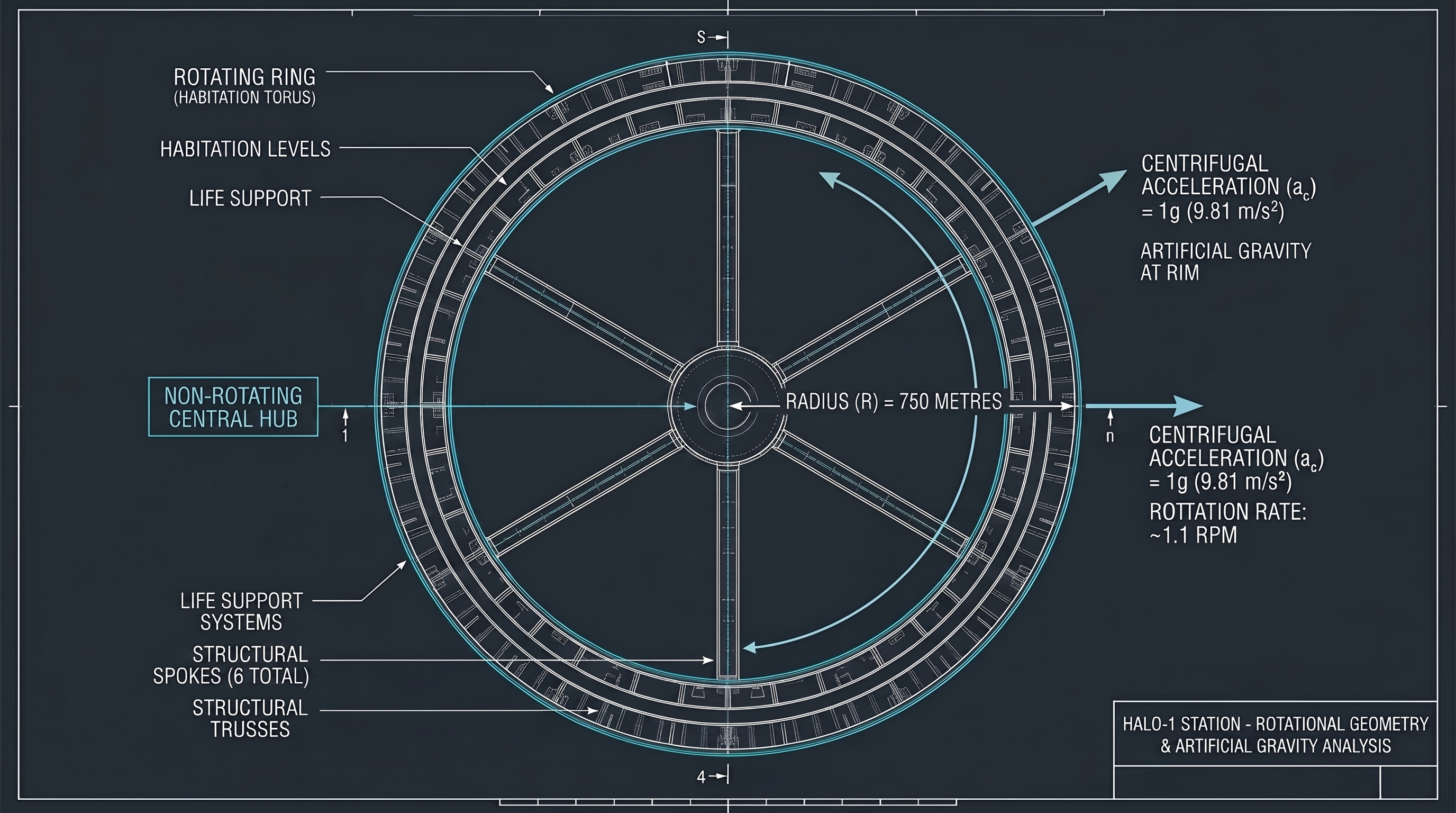
Artificial gravity via rotation is not speculative technology. The physics are well understood. A rotating structure generates centrifugal acceleration that simulates gravitational force at the rim. The design variables are radius and rotation rate. Larger radius permits slower rotation; slower rotation reduces cross-coupled angular effects and inner ear disturbance. For a 1g-equivalent environment, a 750-metre radius ring rotating at approximately 1.1 rpm delivers the target acceleration with minimal vestibular conflict.
This is not a comfort feature. It is an operational baseline. In a 1g environment, crew can walk, run, lift, and manipulate objects with the same biomechanics they have trained for on Earth. Equipment designed for terrestrial industry—machine tools, assembly jigs, materials handling systems—can be used without modification. Fluid systems behave predictably. Dust settles instead of dispersing into filtration systems. Fire suppression protocols are standard. Sleep, digestion, and cardiovascular function proceed without the chronic stressors of microgravity.
Rotation does not eliminate operational complexity. It introduces it in a domain where Earth-based engineering experience is directly applicable.
The alternative is to redesign every process, every tool, and every safety protocol for a microgravity environment, then hope the resulting system can be operated reliably by personnel whose health is deteriorating on a predictable timeline. West Galactic views this as an avoidable risk.
Why HALO-1 begins with rotation.
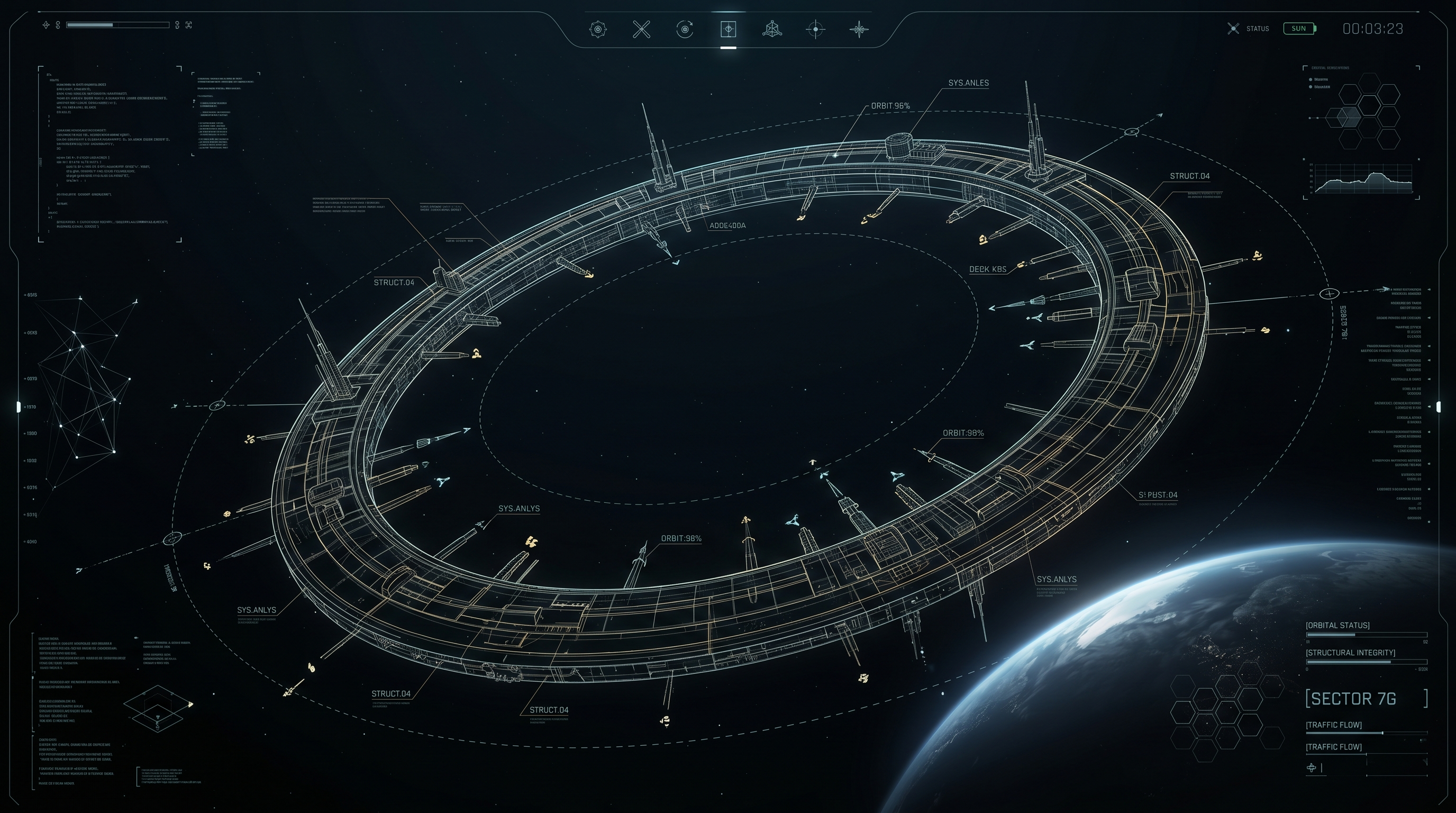
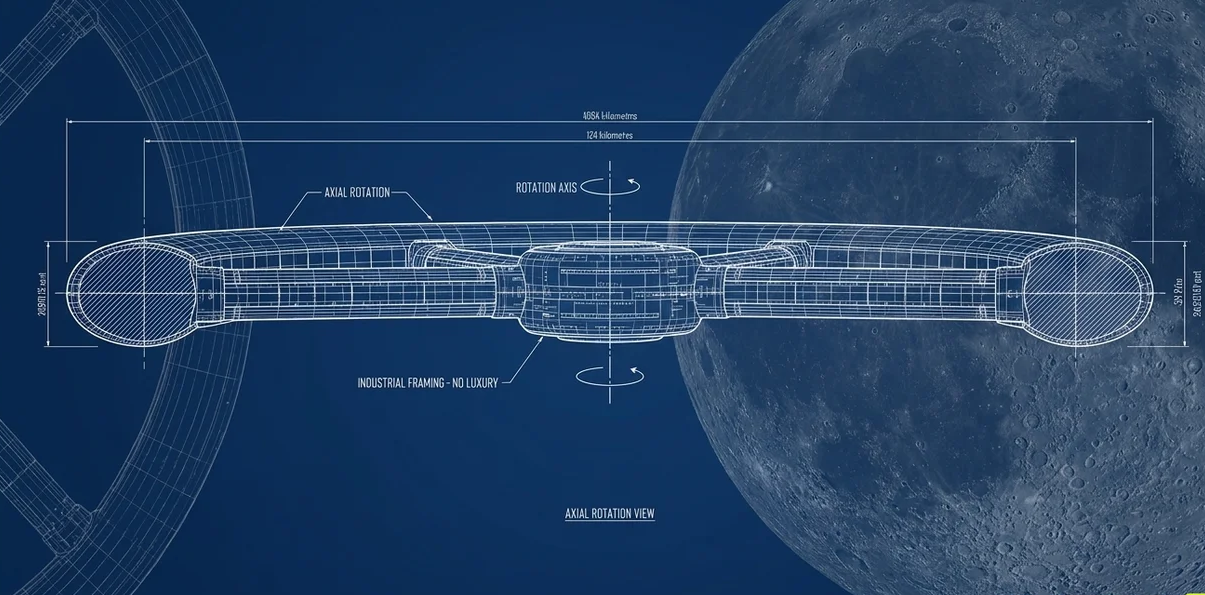
HALO-1 is not a space station in the traditional sense. It is an orbital industrial yard with a 1g-class working environment. The design is a rotating ring structure approximately 750 metres in radius with a mass class of 52,000 tonnes. The ring rotates to provide continuous centrifugal acceleration at the rim. The hub remains stationary for docking, logistics transfer, and zero-g operations where they are advantageous.
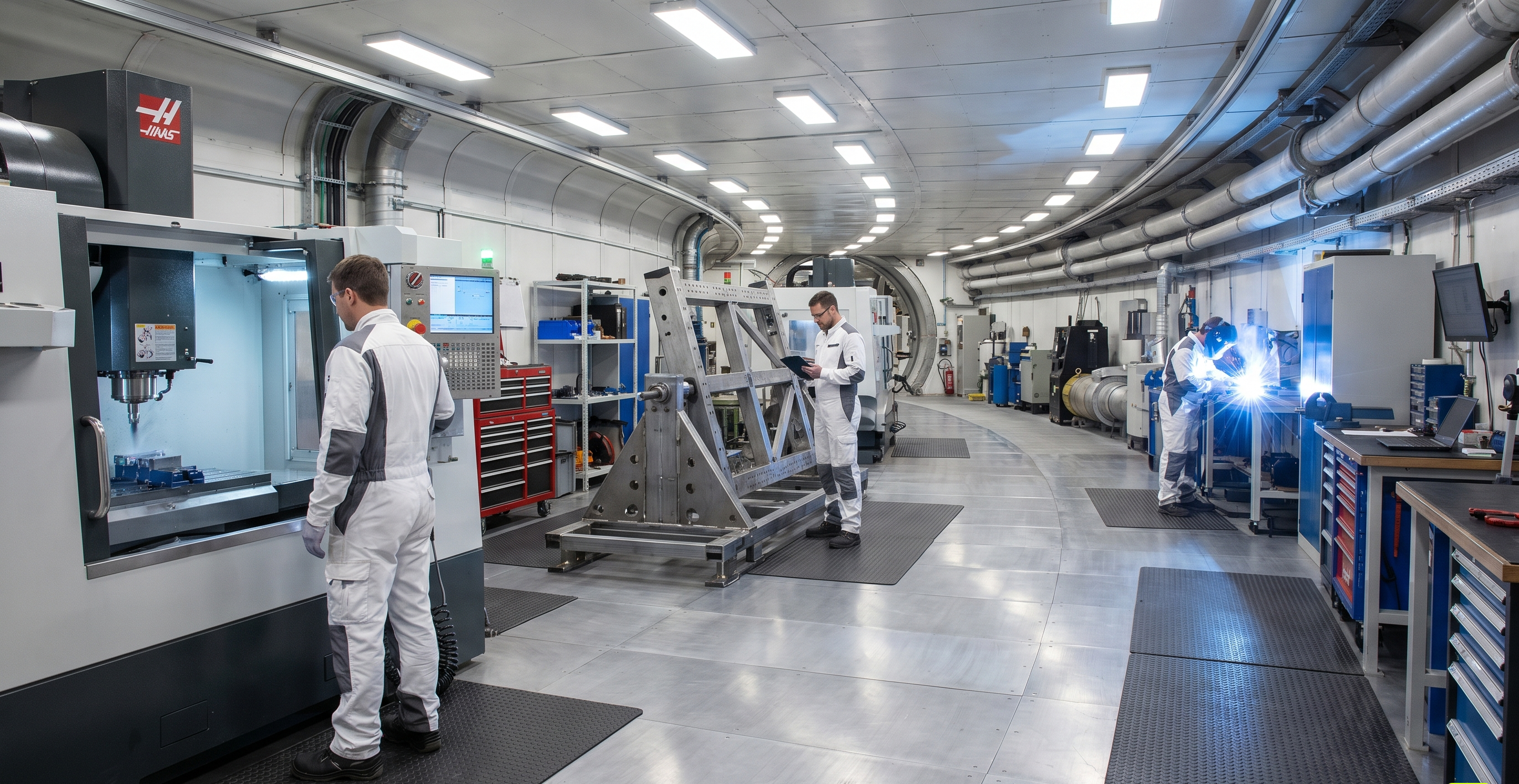
This configuration allows West Galactic to operate heavy fabrication, assembly, and quality assurance processes inside the ring with the same safety and efficiency standards as a terrestrial shipyard. Personnel work multi-year rotations without the physiological cost that would otherwise mandate continuous turnover. Skills transfer from Earth-based industry becomes straightforward. A machinist from Johannesburg, a structural welder from Vancouver, an NDT inspector from Seoul—they arrive with competencies that remain valid in the orbital environment.
The scale is deliberate. A 750-metre radius is large enough to minimise rotation-induced Coriolis effects during movement. A 52,000-tonne mass class provides thermal inertia, structural margin for expansion, and a viable platform for recycling consumables in closed-loop life support. This is not a prototype. It is the minimum credible threshold for industrial operation.
What becomes possible.
With a gravity-capable environment in place, a different set of operational questions becomes tractable. Can we fabricate pressure vessels in orbit that meet terrestrial code standards? Yes, because welding, radiographic inspection, and hydrostatic testing behave the same way. Can we machine structural components to tight tolerances? Yes, because chips fall into collection bins instead of becoming airborne contaminants. Can we store hazardous materials without continuous active containment? Yes, because liquids settle and vapours stratify predictably.
The labour model changes. Multi-year tenures become standard rather than exceptional. Families can be considered for colocation once life support systems mature. The psychological burden of confinement eases when walking, exercising, and sleeping do not require straps, bungees, or pharmacological sleep aids. Recruitment expands beyond astronaut corps demographics to the broader technical workforce.
The economics change. Equipment purchases shift from bespoke spaceflight-qualified units to adapted terrestrial industrial hardware. Training costs decrease because fewer competencies require complete relearning. Throughput increases because tasks are not bottlenecked by vestibular adaptation periods or mandatory exercise countermeasure schedules.
Artificial gravity does not make space easy. It makes space industry plausible.
The integration argument.
The HALO chain is an infrastructure sequence: power, resources, freight, interception, transfer, and rotation. Artificial gravity is not an isolated feature. It is the terminal layer that makes the preceding layers economically viable. Without HALO-1, the orbital environment remains a research domain—valuable for science, marginal for industry. With HALO-1, the cislunar economy gains a platform where fabrication, assembly, testing, and logistics can proceed at the cadence and scale that commercial viability demands.
This does not mean other approaches are invalid. Microgravity manufacturing has niche applications: fibre optics, protein crystals, certain metallurgical processes. But these are laboratory-scale activities. The difference between a laboratory and an industrial base is not one of degree—it is one of kind. An industrial base requires sustained human presence, diverse skillsets, heavy machinery, bulk material flows, and safety margins wide enough to tolerate operational variance. These requirements converge on a single conclusion: gravity is not optional.
West Galactic's thesis is that artificial gravity is the missing infrastructure layer. Not because it is glamorous. Because without it, the rest of the stack remains theoretical.
Common questions
Why 750 metres? Can't a smaller radius deliver 1g?
A smaller radius can technically deliver 1g, but only by increasing the rotation rate. Higher rotation rates amplify Coriolis effects—cross-coupled angular accelerations that cause nausea, disorientation, and difficulty with coordinated movement. At 750 m radius, a 1g environment requires approximately 1.1 rpm. This is below the threshold where vestibular disturbance becomes operationally limiting for most personnel. Smaller radii increase rotation rates into ranges where even adapted crew experience persistent discomfort and reduced task performance.
The 750 m figure is not arbitrary. It reflects the engineering trade-off between structural mass, rotation rate, and human factors tolerance. Going smaller saves mass but imposes physiological costs that degrade industrial productivity. HALO-1 is sized for industrial operation, not minimum viable demonstration.
Has artificial gravity been tested in space?
No crewed rotating structure has been deployed in orbit. Ground-based centrifuge studies and short-radius tethered spacecraft concepts have provided partial data, but no long-duration human occupation in a rotating environment has occurred in space. This is a risk. West Galactic views it as an acceptable risk because the physics are deterministic, the design margins are conservative, and the alternative—scaling industrial operations in microgravity—introduces compounding physiological and operational risks that are harder to bound.
The absence of orbital validation reflects funding priorities, not technical impossibility. Rotating habitats have been understood as feasible since the 1960s. What has changed is the economic case: cislunar resource flows and orbital industrial demand now justify the capital outlay. HALO-1 is the threshold asset where that justification becomes credible.
Why not partial gravity? Does it have to be 1g?
Partial gravity (e.g., 0.4g or 0.6g) is easier to achieve at smaller radii and lower rotation rates, and may provide some mitigation of microgravity health effects. The problem is that partial gravity thresholds for long-term human health are not well characterised. No one has spent a year in 0.4g to determine whether it prevents bone loss or merely slows it. HALO-1 targets 1g because it eliminates the physiological research question. A 1g environment is known to be compatible with indefinite human occupation.
West Galactic is not running a human factors experiment. It is building an industrial platform. The 1g target removes uncertainty in crew health planning, equipment compatibility, and operational safety. If future research demonstrates that 0.6g is adequate, the ring can be operated at reduced rotation rates. Starting at 1g provides the widest operational margin.
What about docking? How do ships connect to a spinning structure?
HALO-1 is a ring rotating around a stationary hub. Docking occurs at the hub, which remains in zero rotation. Arriving spacecraft match velocity with the hub, dock using standard berthing interfaces, and then transfer cargo or personnel to the rotating ring via elevators or transit tubes along the radial spokes. The hub also serves as a staging area for zero-g operations where microgravity is advantageous—satellite servicing, certain precision assembly tasks, or crew transfer to non-rotating vessels.
This hub-and-spoke architecture is not novel. It separates the docking problem from the rotation problem. The engineering challenge is structural—spokes must transmit loads between the stationary hub and the rotating ring—but it is a solved mechanical problem. HALO-1's design incorporates redundant spoke paths and active balancing to manage dynamic loads during cargo transfer and personnel movement.
Is this financially viable? What's the capital requirement?
HALO-1 is a ~52,000-tonne structure. The capital requirement is measured in tens of billions of USD-equivalent. West Galactic does not claim this is inexpensive. The argument is that it is the minimum credible threshold for an orbital industrial base, and that cislunar economic activity—once established—generates sufficient value to service that capital over a multi-decade horizon. The chain architecture (AURORA, MOONFORGE, RAILSTAR, SHEPHARD, AXLEPORT, HALO) is designed to deliver revenue-generating outputs at each stage, not to wait for a single terminal asset.
Financial viability depends on freight cadence, resource throughput, and contract commitments from partners. West Galactic is not seeking speculative venture capital. It is organising a programme around sovereign and institutional partners whose planning horizons align with infrastructure timelines. The capital will come from patient allocators—development finance institutions, sovereign wealth structures, aerospace primes—who recognise that cislunar infrastructure is a multi-decade strategic position, not a quarterly earnings play.