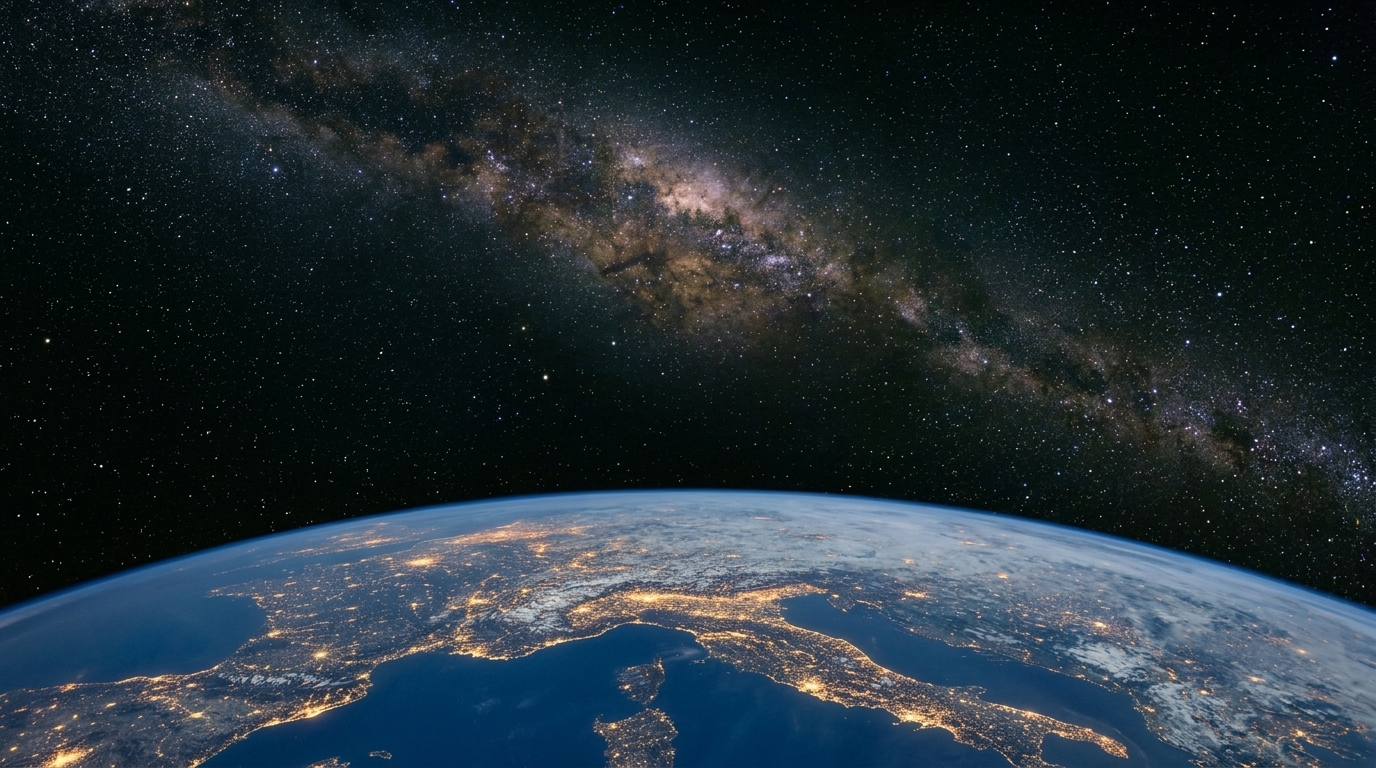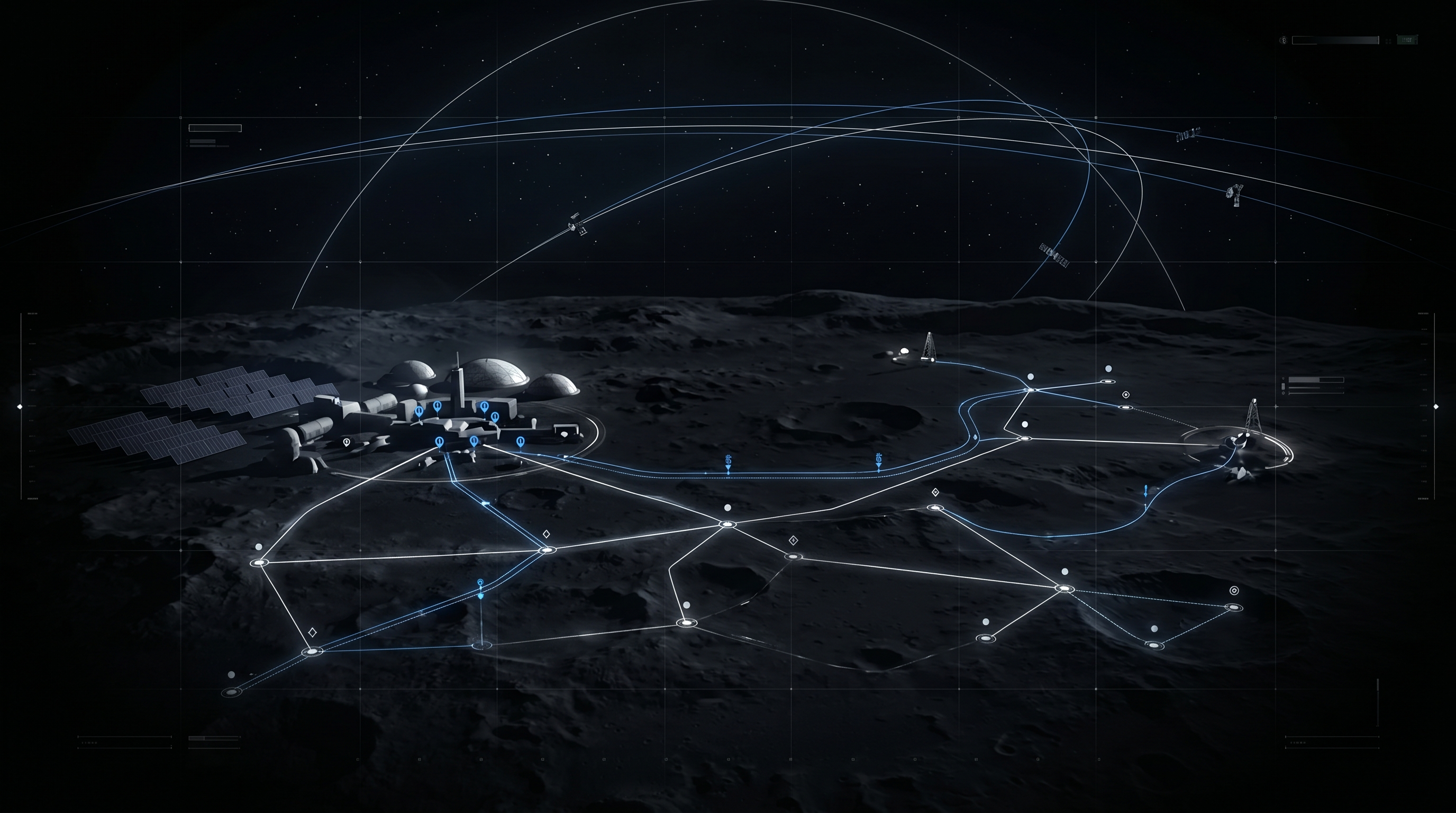
West Galactic LLC was formed in Wyoming on 30 April 2026 (filing 2026-001965390) to organise the operating companies that the cislunar economy will require. AURORA is the first of those layers. Its scope is lunar power infrastructure end to end: generation, storage, transmission, and continuity through the long lunar night. Every subsequent layer in the HALO chain — MOONFORGE's regolith refining, RAILSTAR's electromagnetic launch cadence, SHEPHARD's orbital interception work, AXLEPORT's docking and transfer operations, and ultimately HALO-1 itself — presupposes that AURORA has done its work. This article explains why the order is not negotiable.
The arithmetic of off-Earth work.
Consider what an early-stage MOONFORGE oxygen extraction line actually consumes. Lunar regolith is approximately 42 percent oxygen by mass, but pulling that oxygen out of the silicate matrix requires somewhere between 4 and 10 kWh of electrical energy per kilogram of oxygen produced, depending on the reduction pathway selected. A production cell sized for a single tonne of oxygen per day therefore requires a sustained 200 to 400 kW of electrical supply — before accounting for thermal management, materials handling, or the parasitic loads of the surrounding facility. That is not a peak. That is a continuous baseline, day and night, across the full lunar diurnal cycle.
Move up the chain to RAILSTAR. An electromagnetic mass driver capable of imparting lunar escape velocity to a standardised cargo canister has a muzzle-energy requirement on the order of 5 to 10 megajoules per kilogram of payload. At any meaningful cadence — say, one launch every six hours — the average power draw of the launcher and its supporting infrastructure is measured in megawatts, with peak draws an order of magnitude above that during the launch event itself. Storage discharge alone cannot carry that profile. The system needs persistent generation, persistent transmission, and the ability to ride through both diurnal cycles and the occasional eclipse season at the polar sites where AURORA is concentrated.
The figures above are deliberately rounded and conservative. The point is not the precision of any single number; the point is the order of magnitude. The lunar industrial economy is a kilowatt-to-megawatt problem on every operating site, simultaneously, indefinitely. There is no version of the cislunar economy that begins with anything other than electrical power on the ground. We treat that as the starting condition of the work, not a downstream concern.
Why sequencing matters more than any single technology.
The order of the HALO chain is the invention, not any individual layer within it. AURORA precedes MOONFORGE because regolith cannot be beneficiated, reduced, or refined without sustained electrical supply. MOONFORGE precedes RAILSTAR because the mass driver consumes locally produced propellant, structural feedstock, and shielding products, and because launching empty mass from Earth to feed the driver defeats the purpose of having one. RAILSTAR precedes SHEPHARD and AXLEPORT because no orbital handling logistics matter until cargo is actually being delivered to orbit at cadence. And HALO itself — the rotating-ring class of asset, for which HALO-1 is the threshold case at a roughly 750-metre radius and ~52,000 tonne mass class — depends on every layer beneath it for its mass, its propellant, and its industrial inputs.
This ordering looks obvious in retrospect. It has not been obvious in practice. A great deal of cislunar planning still treats power as a vehicle-level engineering concern — a solar array sized for one mission, a battery pack scaled for a single rover — rather than as an infrastructure layer organised across decades and across operators. We are building West Galactic on the opposite premise: the layer is the unit of work, and AURORA is the layer that comes first.
Three problems, not one.
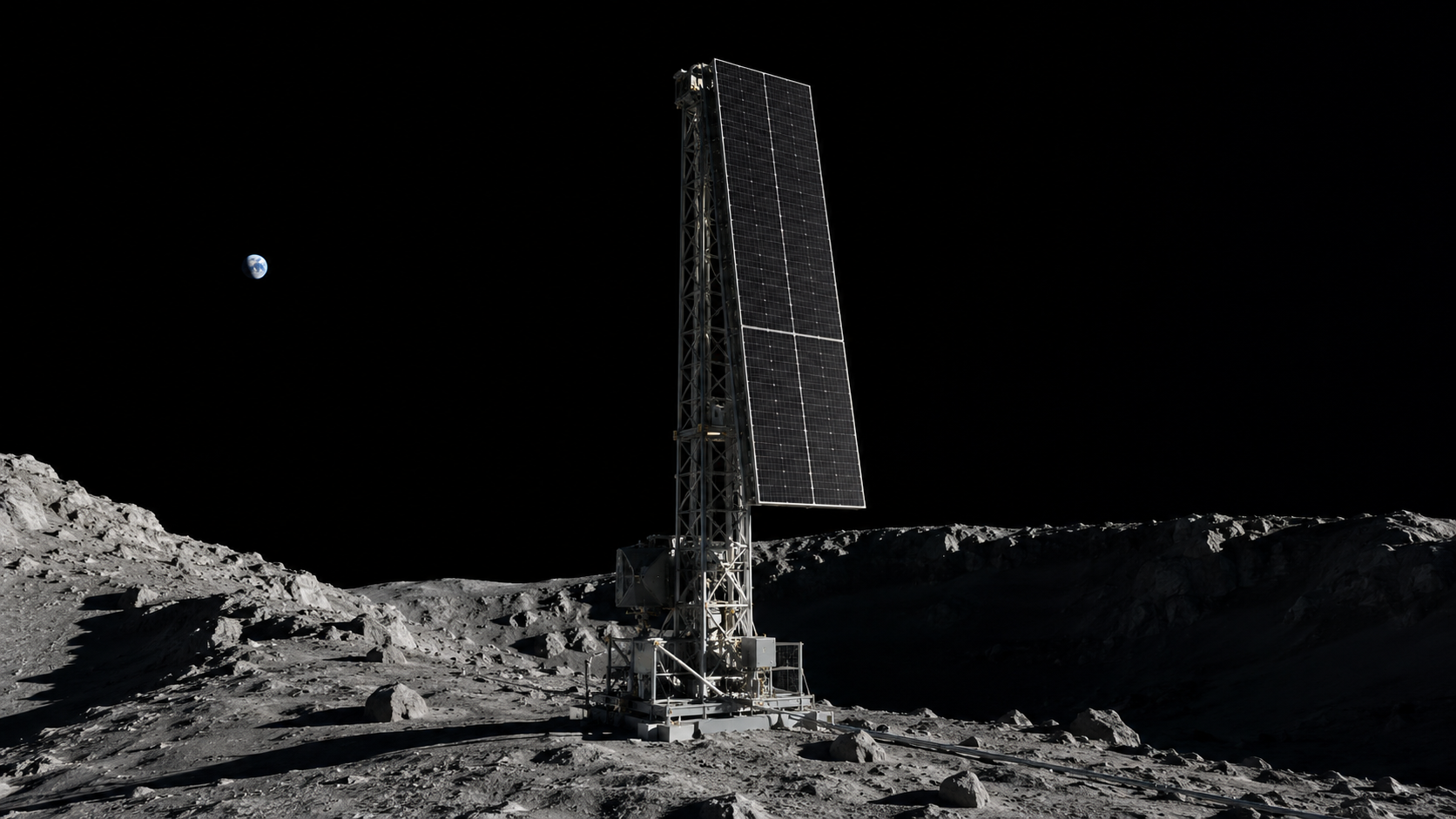
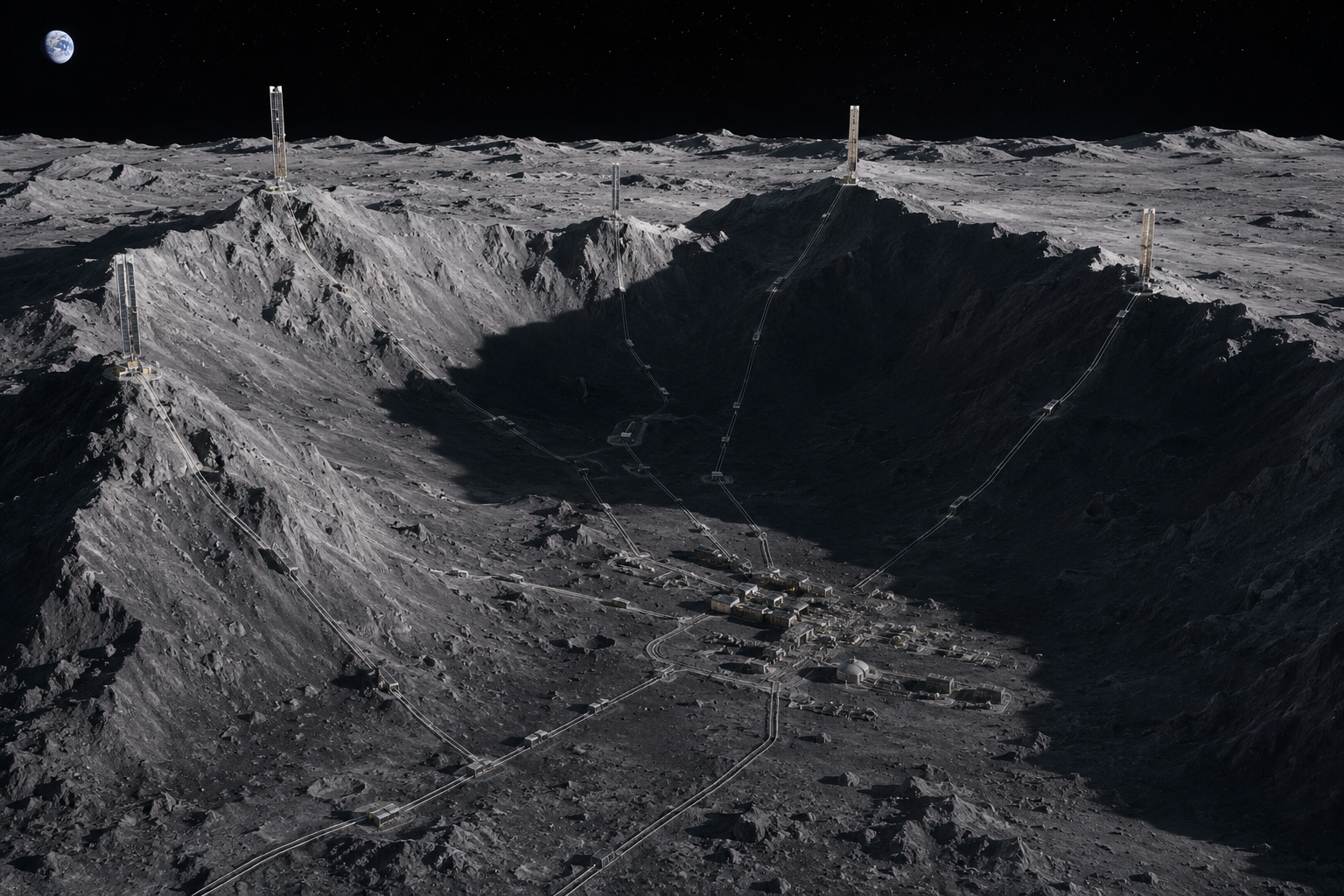
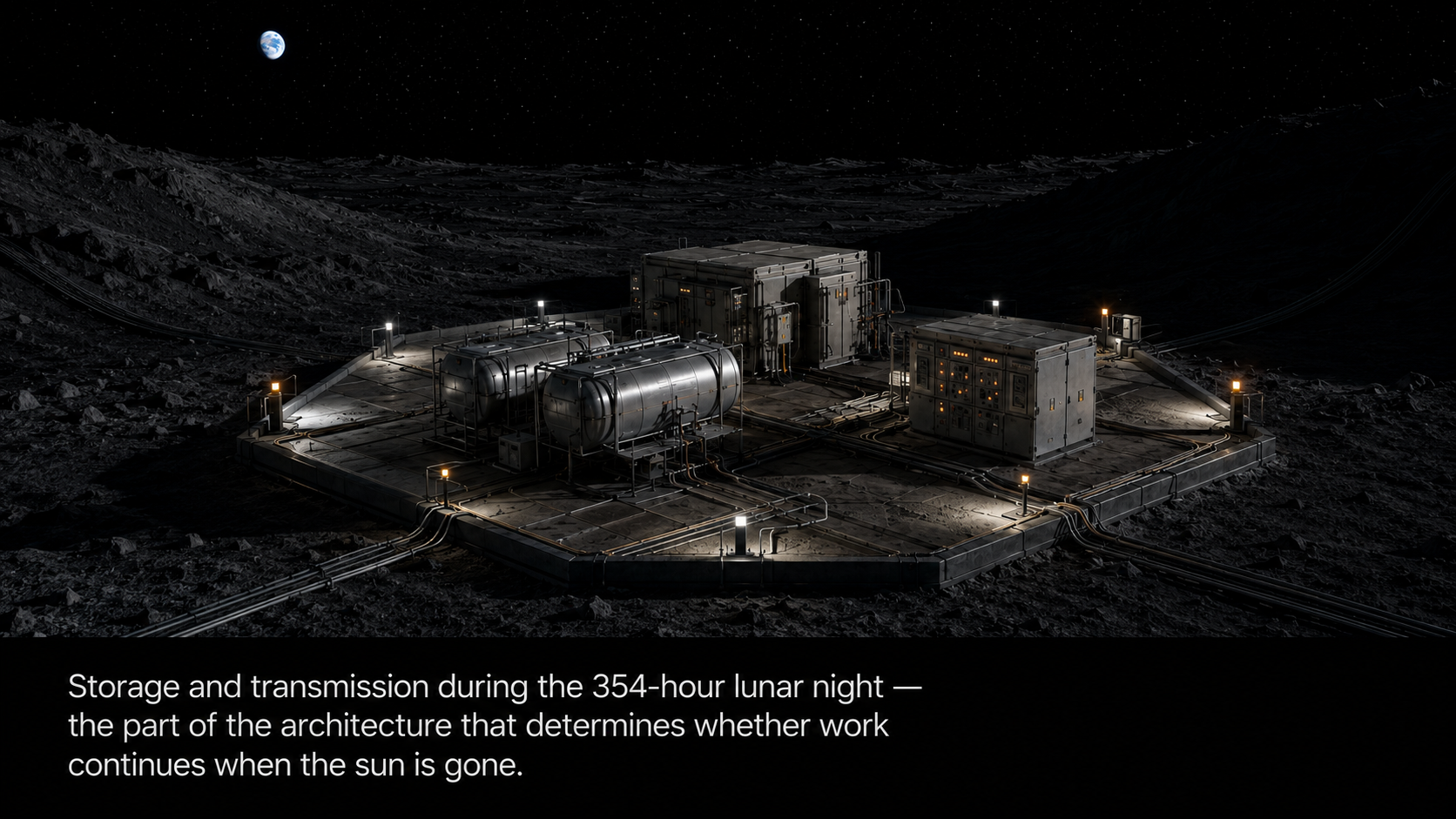
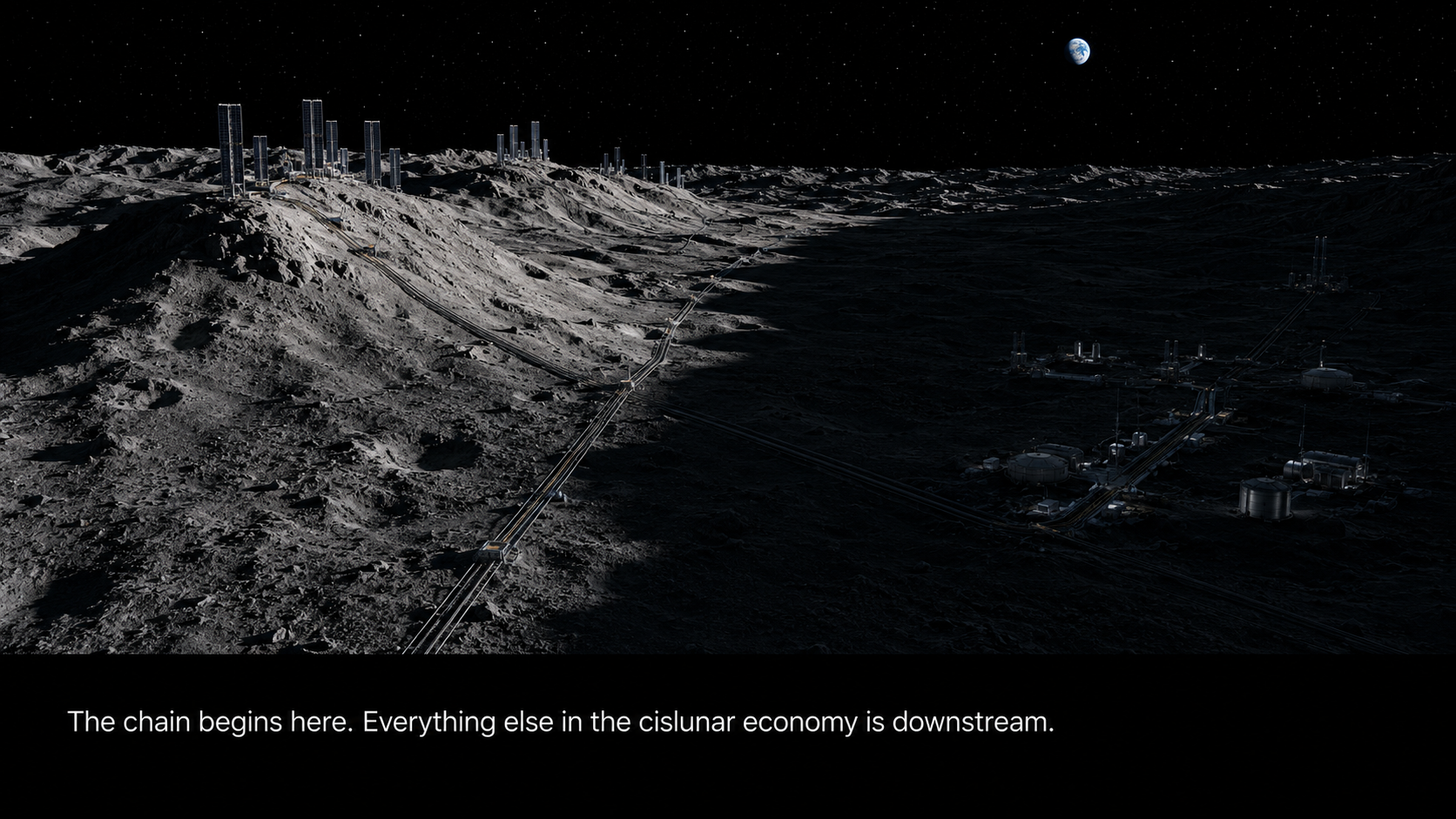
AURORA is not a generation problem. It is three problems, and they have to be solved together. Generation is the most tractable of the three: photovoltaic arrays on tall masts at the lunar polar peaks, where favourable sites along the Shackleton-Connecting Ridge and around Mons Malapert receive direct illumination for roughly 80 to 90 percent of the year. Storage is the harder problem: even the best polar sites have eclipse seasons of multi-day darkness, and any operating site away from the poles experiences the full 354-hour lunar night. Transmission is the unloved third problem — kilometres of cabling, switching, and grid management on a body with no atmosphere, hard vacuum, and a surface thermal range from roughly 120 K to 390 K depending on illumination and latitude.
Energy is not one of the constraints of the cislunar economy. It is the constraint that produces every other constraint.
Solving generation alone is a hardware project. Solving generation, storage, and transmission together is an infrastructure project. The distinction shows up in every interface: in the standards for cable routing across regolith, in the protocols for switching loads during eclipse, in the spare-parts logistics that determine whether a transmission fault on day 600 of operations can be repaired in hours or weeks. AURORA's design intent is to treat all three as a single integrated system, not three separately optimised hardware programs.
What comes next.
AURORA's near-term milestones are scoped at the program level. We are organising the engineering and partnership work needed to define the first generation-scale solar mast, the first storage architecture survivable through a full lunar-night cycle at a non-polar operating site, and the first multi-kilometre surface transmission demonstration. Specific hardware partners, performance targets, and timelines will be published as agreements close. The roadmap reflects the order in which AURORA's subsystems graduate from design intent to deployed capability, and the HALO program page sets out how AURORA's outputs feed each subsequent layer.
The HALO chain is a multi-decade build. AURORA is the first decade. Everything else in the cislunar economy — refining, launching, towing, docking, gravity-class orbital industry — is downstream of the question we are working on now: can we put persistent, transmissible kilowatts on the lunar surface, and keep them there? The work is in service of an answer of yes.
Common questions
Why does AURORA come before MOONFORGE in the chain, rather than running in parallel?
Because MOONFORGE's first useful output — oxygen extracted from regolith — has a continuous power requirement in the hundreds of kilowatts for even a modest production line, and that supply has to exist before the refining hardware is delivered to the surface. Parallel development is fine at the engineering level, but at the deployment level the order is fixed: generation, storage, and transmission have to be standing on the lunar surface before regolith processing can begin.
The same logic propagates up the chain. RAILSTAR needs MOONFORGE outputs. SHEPHARD and AXLEPORT need RAILSTAR cadence. HALO needs all of them. AURORA is the layer that unblocks every other layer, so it is the layer that goes first.
Why solar at the lunar poles rather than fission from the start?
Fission is part of the long-term mix and is not excluded from AURORA's architecture. The reason we treat polar solar as the first generation source is pace of deployment and regulatory tractability: photovoltaic arrays at peaks of near-eternal light can be built up incrementally, scaled by adding masts, and serviced without the institutional overhead of an off-Earth reactor program. Fission is a higher-density complement that becomes increasingly attractive as operating sites move away from the polar illumination corridor and as continuous loads grow into the multi-megawatt range.
What does 'persistent power' actually mean on a body with a 354-hour night?
It means an integrated system. Generation captures sunlight where it is available — primarily at polar peaks for the early phases. Storage carries the load through eclipse periods and through the full lunar night at non-polar sites. Transmission moves power from where it is generated to where the work is done, often across several kilometres of regolith. None of these three components alone provides persistent power; only the combination does. AURORA's program scope covers all three, treated as one system with one set of interface standards.
Is West Galactic building AURORA hardware itself?
West Galactic's posture is to organise and integrate the chain, not to be the sole vendor of every component within it. AURORA's generation, storage, and transmission subsystems will be developed in partnership with hardware specialists, agencies, and supply chains already working in the adjacent fields. Our role is to define the layer, set the interfaces, sequence the deployments, and ensure that the outputs of AURORA are usable by MOONFORGE and the layers above it. Partner inquiries are handled through the partner page.