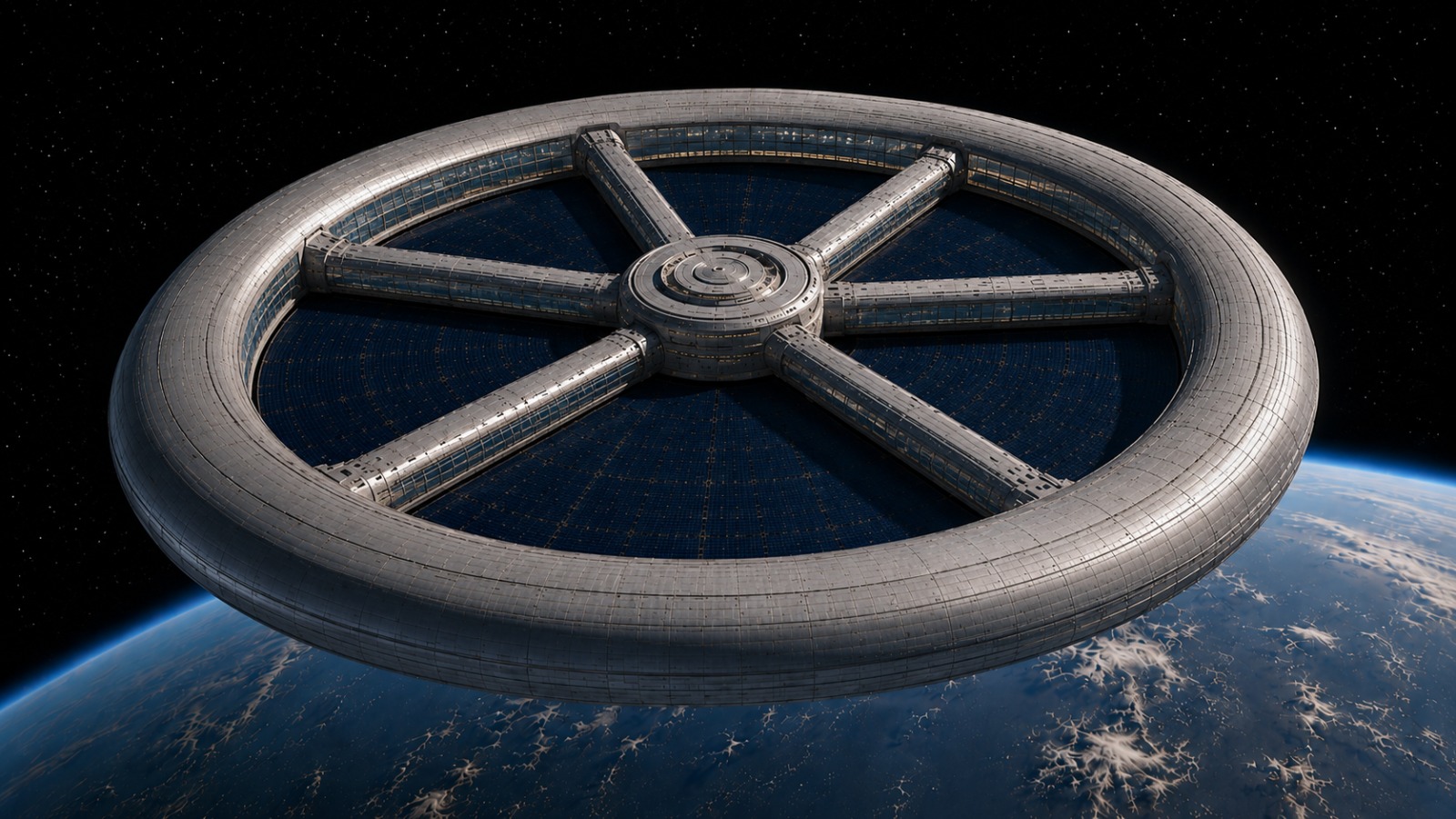
Most of the public conversation about space focuses on rockets. New launchers, new pads, new costs per kilogram. This is understandable. Rockets are vivid, photogenic, and politically legible. They are also genuinely upstream of everything: nothing else moves without them.
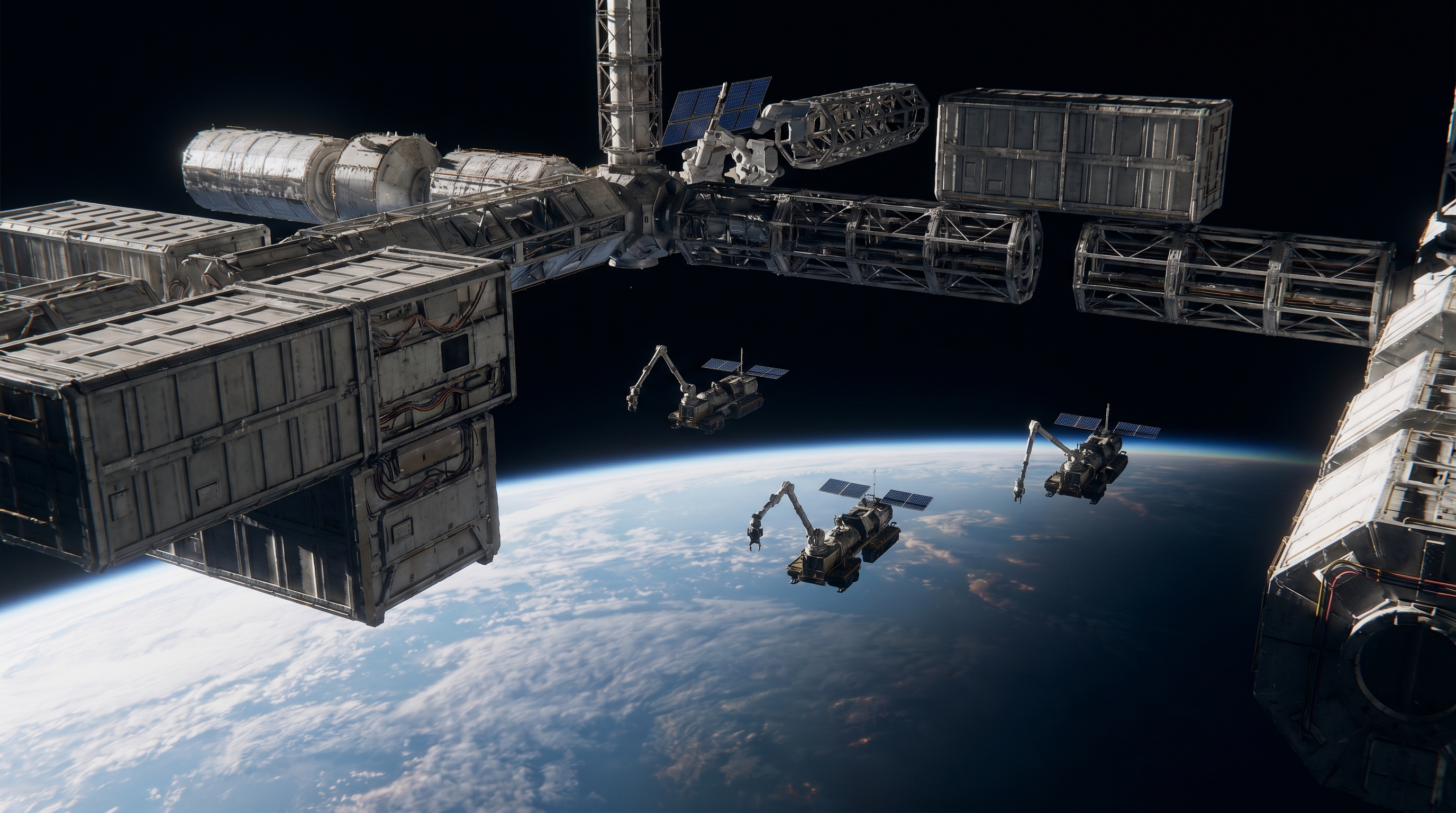
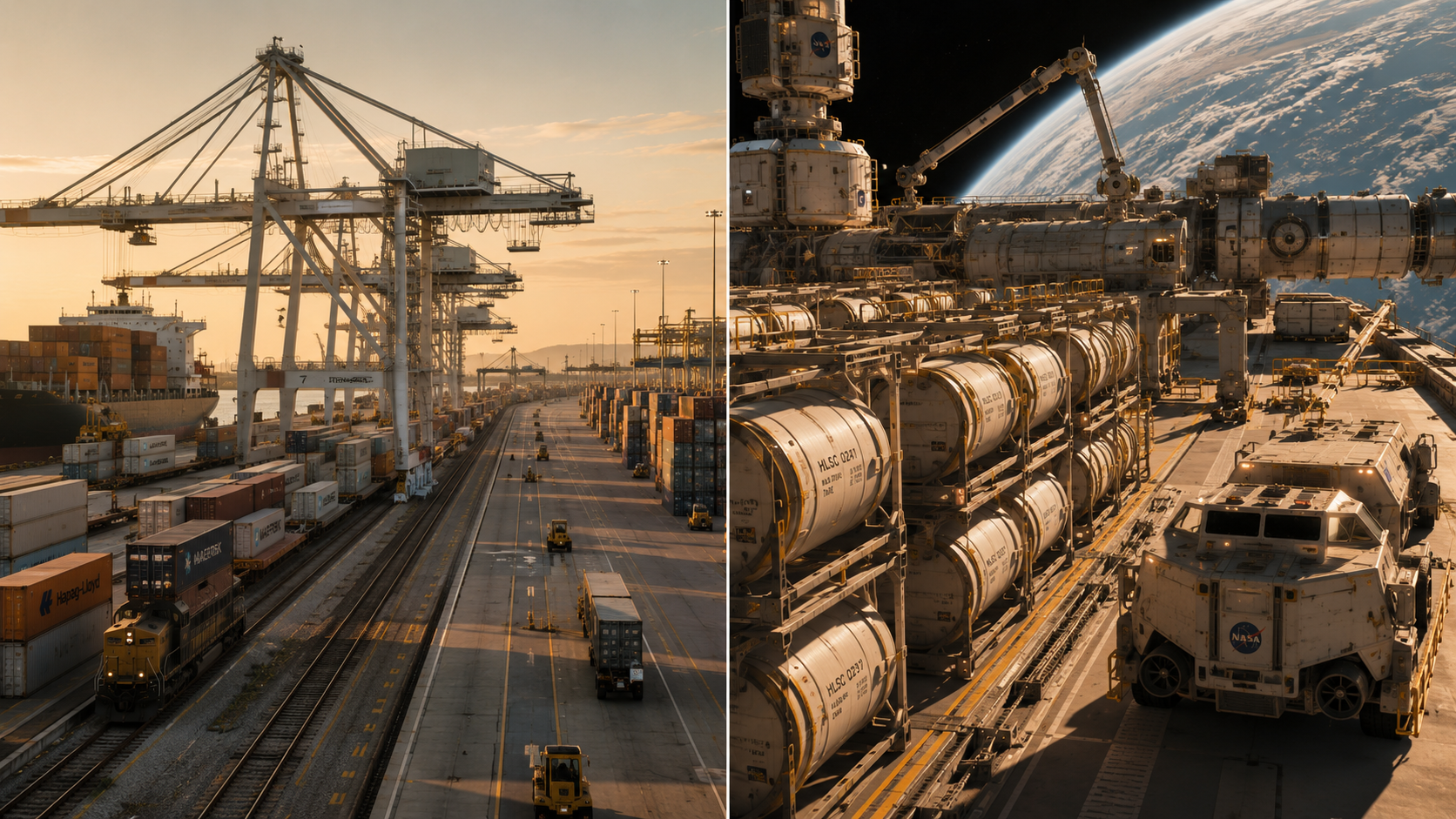
But rockets, as a category, are not the whole space economy. They are its access layer. Roads are upstream of trucks; ports are upstream of ships; airports are upstream of aircraft. None of those access systems are, by themselves, an industrial economy. Roads do not refine ore. Ports do not manufacture machinery. Airports do not run factories. Industries are organised on top of access — they are not the same thing as access.
Space is in the same position. We have, over the last decade, made enormous progress on the access layer. Reusable boosters, larger payload bays, more frequent flight tempo, lower marginal costs per kilogram to LEO. Genuinely impressive engineering work. But the access layer is — by definition — the layer that ends as soon as the payload is delivered. Once a satellite, a rover, or a spacecraft has arrived, the rocket's job is over.
What happens next is currently a series of one-offs. Every payload is a discrete mission. Every kilogram has been hand-engineered, hand-launched, hand-integrated. There are no roads on the other side. There are no ports. There are no warehouses. There are no factories. There are no power grids that anyone else can plug into. Every space activity, no matter how often it repeats, is treated as a fresh expedition.
This is what an access economy looks like before it has an industrial economy on top of it.
The layers between launch and destination
The work required to convert an access economy into an industrial one is not a single step. It is a series of layers — each of which is its own engineering problem, its own commercial logic, and its own operational discipline.
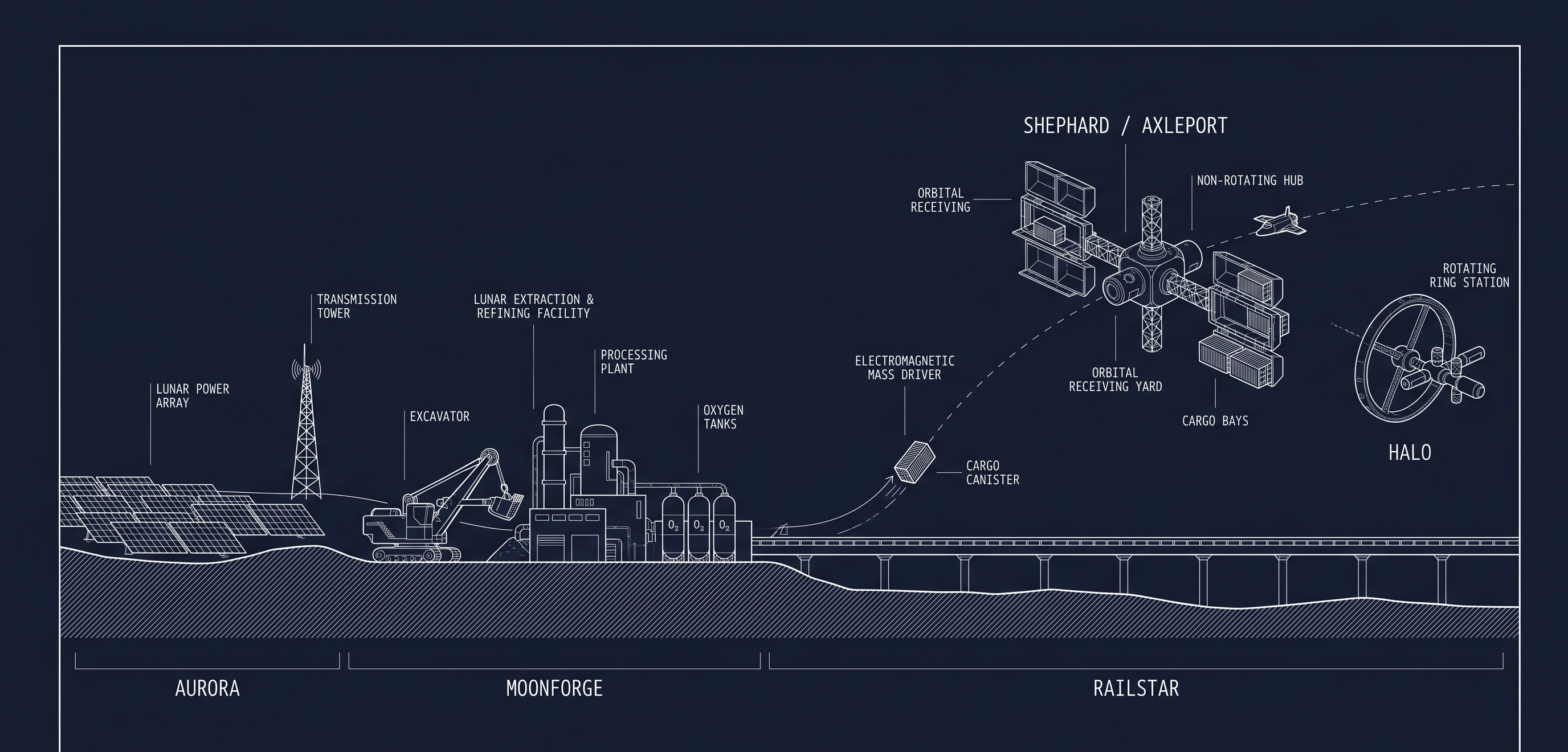
In the cislunar context, those layers include: persistent lunar power, lunar materials and industrialisation, lunar-to-orbit freight, orbital receipt and yard operations, gravity-capable orbital industry. Each layer is upstream of the next. None of them is a rocket. All of them are infrastructure.
Without the power layer, there is no rhythm to lunar industry. Without the materials layer, freight has nothing useful to carry. Without the freight layer, orbital construction stays Earth-dependent. Without orbital receipt and yards, everything assembled in orbit is improvised. Without gravity-capable industrial environments, certain forms of long-duration work simply do not become normal.
These are not optional aesthetic features. They are the same kind of infrastructure that makes any industrial economy possible — translated into the conditions of cislunar space.
Why this distinction matters now
It matters now because we are at the point where access has stopped being the bottleneck. Launch is, for the first time, no longer the rate-limiting step in many serious space discussions. The next limit is the absence of the layers above.
That gap will not close by accident, and it will not close by building more launchers. It will close because specific groups deliberately organise it. That is what an infrastructure company does: it does not arrive at a destination, it builds the conditions under which arriving is repeatable, useful, and economically rational.
West Galactic's posture
West Galactic is deliberately not a rocket company. The HALO program is an infrastructure chain — AURORA for lunar power, MOONFORGE for lunar industrialisation, RAILSTAR for lunar-to-orbit freight, SHEPHARD and AXLEPORT for orbital receipt and yard operations, and HALO itself for gravity-capable orbital industry.
The order is the invention. Each layer proves and enables the next. None of them is a rocket. None of them is a destination. All of them are the connective tissue between access and use — the layer that turns "we got there" into "we can do something there, repeatedly, at scale, with industrial logic."
That is the layer the next phase of the space economy is missing. It is the layer this company exists to organise.
Common questions
Is West Galactic building rockets?
No. West Galactic is structured as a private infrastructure group. The HALO program is the layer of systems that sits between launch and use — power, materials, freight, ports, yards, and gravity-capable orbital industry. We expect to be a customer of launch providers, not a competitor to them.
Why does this company exist if the rocket layer is being solved?
Because solving access is necessary, but not sufficient. An access economy is not the same thing as an industrial economy. The next bottleneck is the absence of the layers above launch, and that is what West Galactic is organised to address.
Is this just a holding company?
West Galactic LLC is the parent platform for a group of operating layers — AURORA, MOONFORGE, RAILSTAR, SHEPHARD, AXLEPORT, and HALO. Each layer matures, partners, and operates with its own logic. The parent's role is to coordinate the chain, not to commercialise a single product.
What is HALO-1?
HALO-1 is the first major orbital outcome of the infrastructure chain — a gravity-capable orbital industrial base, designed for manufacturing, logistics, maintenance, long-duration human work, and modular ring expansion. It is the threshold asset, not the first move.